
SUBSCRIBE PREVIOUS ISSUES
Take Action
Participating in the Surplus Chemical Redistribution Program
The NIH community, especially lab staff, can participate in the Surplus Chemical Redistribution Program either by requesting or donating discarded/unused/unopened/sealed chemicals and reagents that are deemed acceptable for redistribution. Described below are a stepwise instruction for: (i) requesting chemicals and reagents through the
NIH Free Stuff website and/or (ii) donating through the trained Office of Research Facilities (ORF) staff as identified on the NIH FreeStuff site for reutilization.
I. Request for Chemicals and Reagents
When a new NIH lab is starting up, the NIH FreeStuff platform provides many opportunities to utilize a variety of products, including chemicals and reagents through the Surplus Chemical Redistribution Program. The products are made available for free to NIH staff incurring savings of thousands of dollars per year on procurement and disposal costs.
For requesting chemicals and reagents, one only needs to log in to the NIH FreeStuff and either go through the search link or the chemicals and reagents tab as explained in Step 1 and Step 2.
Step 1: Log in to the NIH FreeStuff website (only accessible to NIH staff)
Step 2: On the NIH Free Stuff website, there are two approaches to search for chemicals & reagents:
Approach 1. Click on the “search” tab to browse and search for the chemical or reagent from all items listed on the NIH Free Stuff.
Approach 2: Click on the “Chemicals & Reagents” tab to browse and search only the chemicals and reagents.
Described below are both approaches with respective screenshots.
Approach 1
a. Click on the “search” tab.
b. The “search” tab showcases the entire list of items available on the NIH Free Stuff. Add the item name in the search box. For example, methyl alcohol.
Approach 2
a. Click on the Chemicals & Reagents tab to browse through the list of chemicals.
b. Once the chemicals and reagents tab is selected, the list of chemicals and reagent is displayed for browsing and selection. For example, select methyl alcohol.
c. Once methyl alcohol is clicked as the chemical item for request detailed information on methyl alcohol including description, CASRN# (Chemical Abstracts Service Number), building/room location, manufacturer, quality, quantity, date available, expiration date, etc., is provided.
d. If the product is available, then click on “Make Request.” If, however, another NIH staff has already made a request, then it will show up in the “See All Requests, Comments, and Replies” box. You, as the requester, too, can provide comments, question, or reply in the comment box. Click “Close” if no longer interested in this product.
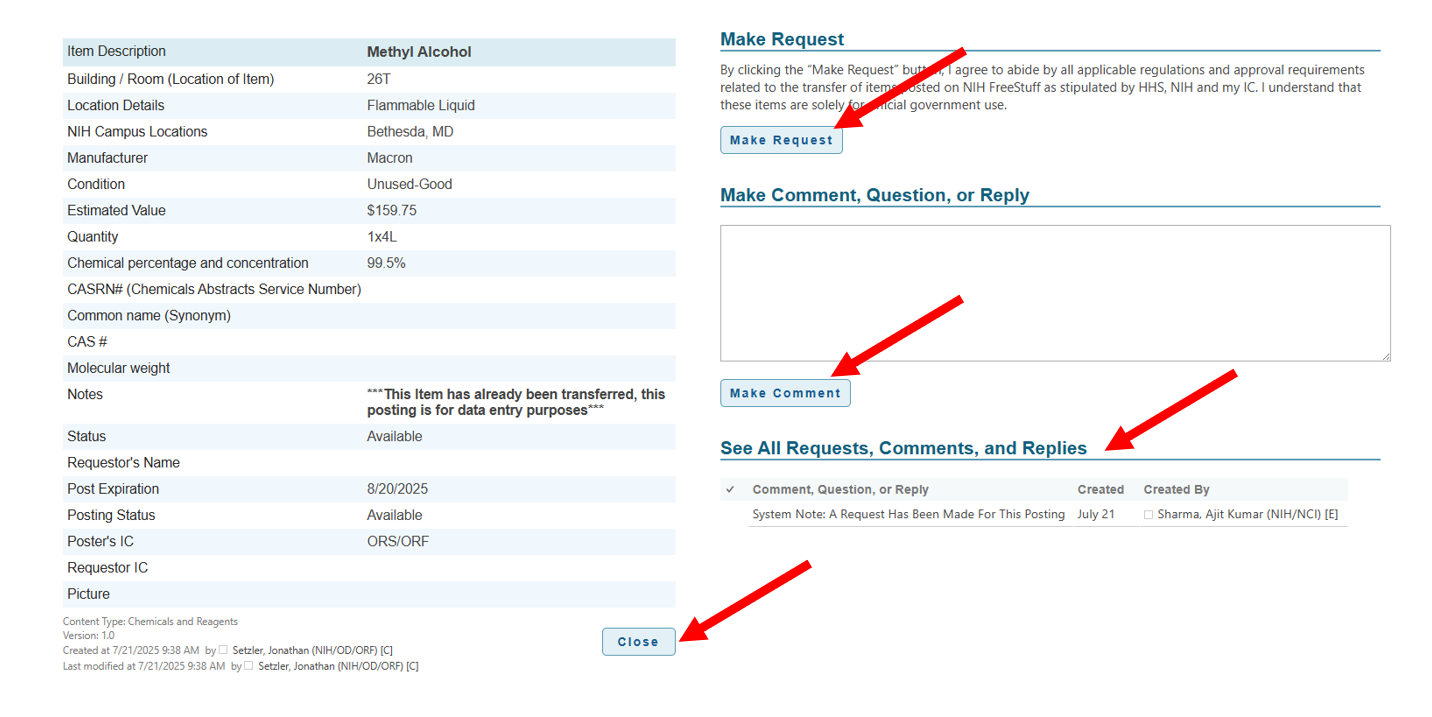
e. Once the chemical/reagent item webpage is closed, it reverts to the list of “Chemicals and Reagents” webpage for resuming search for another chemical or reagent.
II. Donating Chemicals and Reagents
When donating unused/unopened/unexpired chemicals, click on the
NIH Free Stuff website, click on the “Post” tab next to the Chemicals & Reagents tab.
A webpage with the terms and conditions for donating unopened and unexpired reagents as required in Maryland, Montana and North Carolina is provided. Each of these locations have designated NIH staff who can be contacted and/or emailed with the request to pick up the chemicals/reagents.
As listed on the website:
Maryland:Bethesda and Gaithersburg, call (301) 496-4710
Baltimore (BRC/TRIAD), email Lt. Cmdr James Pitt (
pittj@mail.nih.gov)
Note: The donor or the lab requesting chemicals reagents for pickup for discarding could complete the chemical waste tag(s) and write “ATTN : Chemical Surplus for Redistribution” on the tag. Crispin and his team will post your chemical for redistribution. If you have any questions, call Crispin Hernandez at 301-806-0679 or Email (
crispin.hernandez@nih.gov)
North Carolina:Email Antares Nicklow (
nicklowa@mail.nih.gov) or Carranza Smith, (
smith34@mail.nih.gov)
Featured Article

|
NIH Surplus Chemical Redistribution Program
The NIH relies on a steady supply of chemicals and reagents for both research and treatments. To support this requirement while conserving resources and reducing environmental impacts, the Office of Research Facilities (ORF) Division of Environmental Protection (DEP) created the Surplus Chemical Redistribution Program in 2013.
LEARN MORE
|
Spotlight

| NIH Community The success of the Surplus Chemical Redistribution Program is driven by the dedicated support of the NIH community, high product quality, excellent contractor support, consistent cost savings and the ease of participation.
LEARN MORE
|
Fun Fact
Did you know? The Surplus Chemical Redistribution Program has existed at the NIH for over a decade and has earned nearly $1.5M in savings. Across it's total lifespan, the program has been responsible for redistributing more than 130,000 lbs, or roughly 40 bathtubs, of chemicals.
Newsletter Feedback If you found this article useful, please let us know! We appreciate hearing how we might improve our future articles, including topics you would like to read about. Please take a moment to complete this quick feedback form:
The NIH Green Zone Newsletter is a publication intended to inform NIH staff about the Division of Environmental Protection and NIH Green Teams projects and initiatives. The text contained in this newsletter is not copyrighted and can be reprinted without permission. If you use portions of this newsletter in your own publication, we ask that you please credit the source. We welcome your comments and suggestions. Thank you.
|
|---|
|
Division of Environmental Protection | Office of Research Facilities | Office of Management
National Institutes of Health | U.S. Department of Health and Human Services
|