Strengthening Federal Environmental, Energy, and Transportation Management
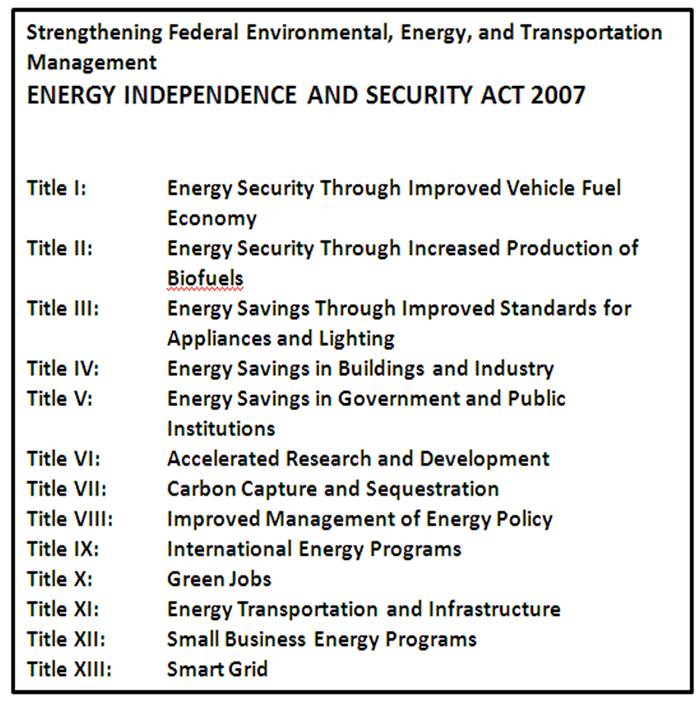
The Energy Independence and Security Act of 2007, also known as EISA 2007, is an energy policy law that consists mainly of provisions designed to increase energy efficiency and the availability of renewable energy.
EISA 2007 sets Federal energy management requirements in several areas:
Including:
Energy Reduction Goals for Federal Buildings
Requires new federal buildings and major renovations to progressively reduce on-site fossil fuel-generated energy consumption compared to a 2003 baseline.
Reduction Targets:
FY 2010–FY 2014: 55% reduction
FY 2015–FY 2019: 65% reduction
FY 2020–FY 2024: 80% reduction
FY 2025–FY 2029: 90% reduction
FY 2030 and later: 100% reduction (zero fossil fuel-generated energy)
Key Requirements:
Baseline: Reductions are measured against a similar building's energy use from Fiscal Year 2003.
Agency Operations: Overall federal agency energy intensity must drop by 3 percent annually through FY 2015.
Evaluations: Agencies must conduct comprehensive energy and water evaluations for 25% of their covered facilities each year.
Standards: Details on compliance and building rules are managed by the Department of Energy.
Facility Management/Benchmarking : Federal agencies must benchmark covered facilities as well as annual energy and water use using standardized digital tools.
- Standardized tools: federal agencies must use the Environmental Protection Agency Energy Portfolio Manager to track monthly energy and water consumption data for all covered buildings.
- Compliance Tracking: Facility and energy managers are required to update performance data annually in the Department of Energy (DOE) web-based EISA 432 Compliance Tracking system.
- Data Fields Required: Basic property details (gross floor area, operating hours, use type, alongside 12 consecutive months of utility metrics (electricity, natural gas, fuel, oil, water, or district energy)
- Public Disclosure: Annual performance metrics are published through FEMP.
Performance and Standards for New Building and Major Renovations
Energy Independence and Security Act: requires federal buildings to meet strict energy performance standards that phase out fossil fuels use over time.
Reduction Targets:
· 90% Reduction: Required for new construction and major renovations where design between FY2025 and FY2029 (compared to FY2003 baseline).
· 100% Reduction (Net-Zero): Required for new construction and major renovations starting in FY2030 or later.
Scope and Threshold Cost: the Department of Energy (DOE) implements these standards through the Federal Building Efficiency Rules. They apply to commercial and residential federal buildings that cross specific cost thresholds.Federally owned public buildings: Threshold approximately $3.6 million in 2024 dollars.
- Federally owned non-public buildings: Threshold approximately $3.8 million in 2024 dollars.
- Leased federal buildings: Threshold approximately $1.8 million in 2024 dollars.
Design Principles: Agencies like the General Services Administration use integrated design principles to optimize energy performance. Conserve water and improve indoor air quality.
High Performance Buildings Energy Independence and Security Act (EISA) established extensive mandates and offices dedicated to high performance green commercial and federal buildings to reduce energy and water use.
Key Provisions for High Performance Buildings
- Federal Offices: Created the Office of Federal High Performance Green Buildings within the General Services Administration (GSA) and an equivalent commercial office in the Department of Energy (DOE).
- Energy Reduction Targets: Mandated that new federal buildings and major renovations reduce fossil-fuel energy consumption by 90% by 2025-2029 and 100% by 2030 compared to a 2003 baseline.
- Leasing Standards: Required large newly leased federal buildings to maintain an Energy Star label.
- Partnership Consortia: Authorized the DOE to formally recognize public private High Performance Green Partnership Consortia to advance green building practices.
Structure and Advisory
- Advisory Committee: Established the High Performance Building Advisory Committee to guide GSA's federal sustainable building strategies.
- Certification Systems: Relies on third party verification benchmarks such as LEED, Green Globes and Energy Star.
Energy Savings Performance Contracts
Permanently reauthorizes permanently reauthorized Energy Savings Performance Contracts (ESPCs) for federal agencies by removing prior statutory sunset dates, according to the Department of Energy (DOE).
Key Provisions under EISA:
- Permanent Authority: Section 513 prevents federal agencies from restricting contract lengths to less than 25 years.
- Expanded Savings Definition: Section 515 broadened energy savings to include cogeneration, heat recovery, onsite renewables, and efficient water use.
- Retention of Savings: Section 516 allows agencies to keep the full amount of cost savings earned through utility incentive programs.
- Training Authorization: Section 517 funded training programs for contracting officers negotiating these agreements.
- Non-building Applications: Section 518 directed studies on utilizing ESPCs for vehicles and equipment generating electricity or transporting water.
Metering
The Department of Energy FEMP Metering Guidance outlines federal requirements under the Energy Independence and Security Act (EISA) of 2007.
Core Metering Mandates:
- Expanded Utilities: While the Energy Policy Act of 2005 required advanced electricity metering, EISA 2007 extended the requirement to include natural gas and steam for appropriate federal buildings
- Implementation Deadlines: EISA 2007 established a fiscal year 2016 deadline for full advanced utility metering across applicable federal facilities.
- Data Tracking: Agencies must integrate collected meter data into tracking systems to benchmark performance and support energy reduction goals
Compliance and Best Practices:
Covered Facilities: Under EISA Section 432, agencies identify major facilities representing at least 75% of their facility energy use for targeted evaluations and tracking.
- Implementation Plans: Agencies maintain five-year meter implementation plans to prioritize installations, address resource limits, and outline paths for remaining buildings (using tools like the Department of Energy FEMP Guidance).
Energy-Efficient Product Procurement
The Energy Independence and Security Act require federal agencies to procure energy-efficient products that carry the Energy Star label or are designated by the Department of Energy's Federal Energy Management Program.
Core Procurement Requirements:
- Mandatory Selection: Federal agencies must purchase ENERGY STAR certified items or products in the upper 25% of energy efficiency for their class as designated by FEMP.
- Contractor Compliance: Contractors working in federally controlled facilities or supplying energy-consuming products must ensure those products meet these high-efficiency standards.
- Planning Integration: Agencies must incorporate these efficiency criteria into all project specifications, solicitations, and evaluation factors.
- Covered Products Category:
- Lighting and Appliances: Includes commercial and residential lamps, refrigerators, washers, and dishwashers.
- Office and Home Electronics: Covers computers, monitors, and electronic equipment.
- Commercial Equipment: Includes food service items, commercial coolers, and heating/plumbing fixtures
Exceptions and Exemptions:
- Non-Availability: Products not listed under ENERGY STAR or FEMP programs are exempt.
- Combat Exception: Equipment designed or procured specifically for combat or combat-related missions is excluded.
- Written Approval: Any deviation requires written authorization from the designated contracting officer.
Office of Management and Budget (OMB) Reporting
Under the Energy Independence and Security Act the Office of Management and Budget (OMB) must submit an annual report to Congress summarizing federal agency efforts and progress in energy efficiency.
Key OMB Reporting Requirements
- Agency Reports: Federal agencies must submit annual reports detailing their status on improving energy efficiency, cutting energy costs, and reducing greenhouse gas emissions.
- OMB Summary Report: OMB compiles these individual agency findings into an annual government efficiency report for Congress
- Progress Evaluation: The OMB report evaluates overall federal progress toward energy reduction goals.
- Recommendations: OMB provides recommendations for extra actions needed to meet energy and greenhouse gas targets.
- Scorecards: OMB also uses data to track and score individual agency compliance and efficiency results.
Reducing Petroleum/Increasing Alternative Fuel Use
The Energy Independence and Security Act (EISA) of 2007 reduces petroleum use and increases alternative fuel use through aggressive vehicle efficiency mandates, expanded biofuel targets, and federal fleet requirements.
Corporate Average Fuel Economy (CAFE)
- Boots Fuel Standards: Requires automakers to raise fleet-wide gas mileage to at least 35 miles per gallon (mpg) for passenger cars and light trucks by the 2020 model year.
- Improves labeling: Directs the government to create clearer vehicle labeling so consumers can easily compare fuel economy and greenhouse gas (GHG) emissions
Renewable Fuel Standard
- Expands biofuel volumes: Greatly expands the national RFS to require 36 billion gallons of renewable fuels annually in the transportation mix by 2022.
- Sets categories: Establishes staggered targets for conventional biofuels (like corn ethanol capped at 15 billion gallons) and advanced biofuels, including cellulosic biofuel and biomass-based diesel.
- Requires emissions reductions: Mandates that qualifying alternative fuels achieve specific lifecycle GHG reductions compared to a 2005 baseline (e.g., 60% for cellulosic biofuel).
Federal Vehicle Fleets
- Reduce petroleum use: Requires federal agencies to reduce their annual petroleum consumption by at least 20% by October 1, 2015, using a 2005 baseline.
- Raises alternative fuel use: Directs federal agencies to increase annual alternative fuel consumption by 10% yearly or achieve a 10% overall increase by 2015.
Infrastructure and Technology Grants
- Funds renewable blends: Authorizes grants for infrastructure development supporting high-level renewable fuel blends (10% to 85% ethanol) and fueling corridors.
- Promotes advanced tech: Provides loans and grants for advancing battery technology, plug-in hybrids, and electric vehicle production.
This content is intended as a reference only. You should refer to the full text of E.O. 13423 for more details (FULL TEXT) Web link -
http://frwebgate.access.gpo.gov/cgi-bin/getdoc.cgi?dbname=110_cong_public_laws&docid=f:publ140.110
Table 3 – EISA 2007 Outline